I thought this was important to share from an email I received. Dr Steve is a friend of mine and has aligned himself with the Shaklee Corp as well. Having been with a company that I could trust for 37 years knowing that the science and safety are first and formost makes me proud.
3 Weight Loss Scams To Avoid
Weight Loss, Wealth Loss, Or Health Loss?
Author: Dr. Stephen Chaney
3 Weight Loss Scams To Avoid
 P.T. Barnum once said
“There’s a sucker born every minute”. Those words were never truer than
in the weight loss industry.
P.T. Barnum once said
“There’s a sucker born every minute”. Those words were never truer than
in the weight loss industry.
You’ve seen the ads: “Lose 4 pounds/week of
belly fat”; “Lose 40 pounds in two weeks”; “burns off fat effortlessly”; “The
pounds just melt away”. It’s hard to believe that people actually fall for
those ads. Yet they do.
The problem is that weight loss is hard. You
have to change your lifestyle – eat healthier, exercise more, give up some of
your favorite foods. Even worse you can’t just make those changes for a few
weeks or a few months. Those lifestyle changes need to be permanent if you wish
to achieve lasting weight loss.
That just doesn’t fit with the American psyche.
After all, our doctors and the TV ads promise us a “pill for every ill”. If you
think that way, it is only logical that there should be a pill for weight loss.
Unfortunately, the unscrupulous supplement
manufacturers are only too happy to fill that expectation. They don’t care
whether their products actually work or whether they may actually kill you.
They just want to make a quick buck.
Here are the 3 weight loss scams making
headlines today.
Fake Weight Loss Marketing Schemes
 The first 2 weight loss
scams fall into the category of ones that lighten your wallet. In a recent press release
the FTC recently charged two Florida-based supplement manufacturers of
concocting elaborate, but completely fraudulent, marketing schemes to sell
their weight loss products – one containing forskolin and another containing
white kidney bean extract.
The first 2 weight loss
scams fall into the category of ones that lighten your wallet. In a recent press release
the FTC recently charged two Florida-based supplement manufacturers of
concocting elaborate, but completely fraudulent, marketing schemes to sell
their weight loss products – one containing forskolin and another containing
white kidney bean extract.
The schemes started with the marketers hacking
people’s email accounts and sending messages touting the fake products to all
of their contacts. The messages were worded in such a way that the email
appeared to be a recommendation of the product coming from a trusted friend or
family member.
The emails were linked to fake “news websites”
that were designed to look like they were put up by an independent consumer
reporter who had reviewed and endorsed the product rather than by the product
manufacturers. These web sites featured glowing testimonials from consumers who
had supposedly lost significant weight using those products. Of course, the
fake “news websites” contained links that took consumers to websites where they
could purchase the products.
In the complaint they filed in court, the FTC
said “these weight loss claims are false and lack scientific support”. In plain
English, the FTC was saying that the testimonials were made up and there was no
scientific evidence that the products actually worked. The fake “news websites”
also said that the products were endorsed by Oprah and a television show called
“The Doctors”. The FTC said that both of those claims were also false.
And, if all of this weren’t enough, the
defendants in these two cases then approached people who had legitimate health
and weight loss blogs with large followings and offered them affiliate status
if they would feature links to the fake “news websites” the defendants had
constructed. In plain English, affiliate status means that the owners of the
blogs receive a commission whenever someone started from their blog and clicked
all the way through to one of the defendant’s sites and bought a product*.
The FTC is seeking an immediate injunction that
would shut down these fraudulent marketing schemes and prevent the companies
from selling fake products that don’t work. I hope the FTC is successful at
obtaining the injunction against both companies, and I hope it happens quickly.
Unscrupulous manufacturers like this need to be put out of business.
*Just so you know, I have also been approached
by companies offering “Health Tips From the Professor” affiliate status for
marketing their products. I have chosen not to do that. I don’t want to become
like so many other popular health blogs that seem to be more about marketing
than about health. I will not feature any product I don’t believe in on my
site. Integrity is more important than money.
Weight Loss Products That Might Actually Kill You
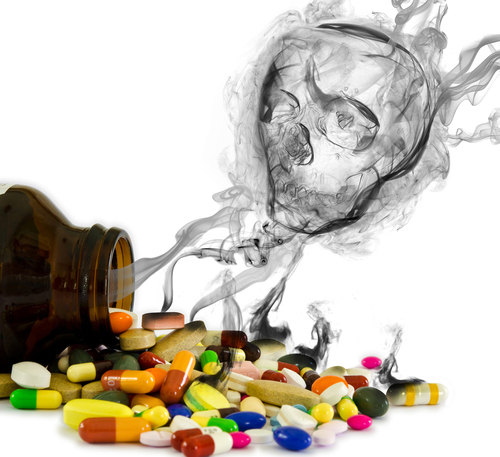 The third weight loss scam
is of the more dangerous kind – one that might even kill you.
The third weight loss scam
is of the more dangerous kind – one that might even kill you.
The FDA recently sent a warning letter
to a marketing company called The Ultimate Weight Loss Company claiming that 3
of their weight loss products that were labeled as containing bee pollen
actually contained two undeclared drugs that the FDA has banned for consumer
use.
The first undeclared drug in their products is
a compound called phenolphthalein, which was widely used in laxative drugs. It
was also widely used in weight loss products because its laxative effect also
causes water loss from the body – giving the appearance of rapid weight loss.
However, research in the 90s suggested that it also increased the risk of
several cancers. Laxative and weight loss drugs containing phenolphthalein were
subsequently withdrawn from the market, and the FDA currently classifies
phenolphthalein as an unapproved drug.
The second undeclared drug in their products is
a compound called sibutramine. Sibutramine suppresses appetite and increases
metabolic rate. It was the active ingredient in a weight loss drug called
Meridia, which was initially approved by the FDA in 1997.
The problem is that, like many drugs that
increase metabolic rate, sibutramine also increases heart rate. While that is
relatively benign for some people, it can cause arrhythmia, heart attack and
stroke in anyone with a weakened cardiovascular system.
A large clinical study published in 2010 (James et al, New
England Journal of Medicine, 363: 905-917, 2010) showed that Meridia
significantly increased the risk of heart attack and stroke in subjects with
preexisting heart disease. Shortly after that the FDA declared that it caused
an unacceptably high risk of heart attack and stroke, and it was withdrawn from
the market. The FDA currently classifies subutramine as an unapproved drug as
well.
Of course, some of you are probably saying to
yourself: “My heart is fine. If this drug suppresses my appetite and revs up my
metabolism, where can I get it?”. My response is: “Not so fast. Here are a few
statistics you should know”:
- 47% of
Americans are at risk for heart disease, and many don’t know that they
 have
a problem until they drop dead from their first heart attack.
have
a problem until they drop dead from their first heart attack.
- If you are
overweight your probability of having heart disease increases by 50% if
you are a middle-aged woman and by a whopping 72% if you are a middle aged
man (Eckel,
Circulation, 96: 3248-3250, 1997).
- According to
the NIH if
you have diabetes, you are 2-4 times more likely to have heart disease.
65% of people with diabetes will die from a heart attack or stroke.
Unfortunately, the combination of
phenophthalein and sibutramine are still used in fraudulent weight loss
products because they work. These two drugs together might actually give you 10
pounds or more of weight loss in the first couple of weeks. They might also
kill you.
In their warning letter to The Ultimate Weight
Loss Company the FDA said that their products pose “a threat to consumers
because sibutramine is known to substantially increase blood pressure and/or
pulse rate in some patients and may present a significant risk for patients
with coronary artery disease, congestive heart failure, arrhythmias, or stroke.
This product may also interact, in life-threatening ways, with other
medications a consumer may be taking”
The problem is not just that the weight loss
products manufactured by this company contained unapproved drugs that are
dangerous. The problem is that those compounds weren’t on the label. The label
claimed the products contained bee pollen. The consumer had no way of knowing
that the products might be dangerous.
Even worse, as soon as the FDA shuts down this
company, another one will pop up somewhere else. The combination of
phenolphthalein and sibutramine is a weight loss scam that turns up time after time.
How Can You Protect Yourself From Weight Loss Scams?
It is definitely “buyer beware” in the weight
loss industry. Unscrupulous manufacturers and weight loss scams abound. You
have learned from this article that:
- You can’t
trust testimonials. They are often fabricated.
- You can’t
trust before and after pictures. They can be photoshopped and purchased
over the internet.
- You can’t
trust endorsements by celebrities or doctors. Endorsements can be bought
and sold, and sometimes they are just fabricated.
- You can’t
trust claims about “proven results”. They often aren’t backed by real
science.
- You can’t
even trust product labels. Some products contain dangerous ingredients
that aren’t even on the label.
- You can’t
even trust the FDA and FTC to protect you. They are doing their best, but
two new scams pop up for every one they shut down.
So what can you do to keep from being ripped
off or endangering your health? Here are my top 4 recommendations for avoiding
weight loss scams.
1) Don’t be taken in by
claims of rapid weight loss, effortless weight loss, or “magic” ingredients.
The experts tell us weight loss should not exceed one or two pounds per week
and should include lifelong lifestyle change. If the ads claim anything else,
run in the other direction.
2) There are no “magic”
foods or “magic” combinations of protein, fat and carbohydrate. It also doesn’t
matter whether the diet is Paleolithic age or space age. Weight loss simply
requires calories in to be less than calories out.
3) Look for clinical
studies published in peer reviewed scientific journals showing that the weight
loss program actually works.
4) Choose companies
that have established a reputation for quality and integrity over a period of
decades, not just a few months or a year or two. Scams come and go. Good
reputations take a long time to develop.
The Bottom Line
Weight loss scams have been in the headlines
recently.
1) The FTC recently
announced legal action two companies selling weight loss products containing
forskolin or white kidney bean extract. According to the FTC the companies were
using a “fraudulent marketing scheme” and the weight loss claims for their
products were “false and lacked scientific support”.
2) The FDA recently
announced legal action against a company selling three weight loss products
which they claimed contained bee pollen, but which actually contained two
unapproved and dangerous drugs that can cause heart attack and stroke in
susceptible people.
In both cases the products seemed legitimate.
They seemed safe. When you read the details of the FTC and FDA cases it becomes
apparent that:
- You can’t trust
testimonials. They are often fabricated.
- You can’t
trust before and after pictures. They can be photoshopped and purchased
over the internet.
- You can’t
trust endorsements by celebrities or doctors. Endorsements can be bought
and sold, and sometimes they are just fabricated.
- You can’t
trust claims about “proven results”. They often aren’t backed by real
science.
- You can’t
even trust product labels. Some products contain dangerous ingredients
that aren’t even on the label.
- You can’t
even trust the FDA and FTC to protect you. They are doing their best, but
two new scams pop up for every one they shut down.
In the article above you will find my top 4
recommendations for avoiding weight loss scams.
These statements have not been evaluated by the
Food and Drug Administration. This information is not intended to diagnose,
treat, cure or prevent any disease.
Dr. Steve Chaney
Health Tips From the Professor
About The Author
 Dr. Chaney has a BS in Chemistry from Duke University and a PhD in
Biochemistry from UCLA. He is Professor Emeritus from the University of North
Carolina where he taught biochemistry and nutrition to medical and dental
students for 40 years. Dr. Chaney won numerous teaching awards at UNC,
including the Academy of Educators “Excellence in Teaching Lifetime Achievement
Award”. Dr Chaney also ran an active cancer research program at UNC and
published over 100 scientific articles and reviews in peer-reviewed scientific
journals. In addition, he authored two chapters on nutrition in one of the
leading biochemistry text books for medical students.
Dr. Chaney has a BS in Chemistry from Duke University and a PhD in
Biochemistry from UCLA. He is Professor Emeritus from the University of North
Carolina where he taught biochemistry and nutrition to medical and dental
students for 40 years. Dr. Chaney won numerous teaching awards at UNC,
including the Academy of Educators “Excellence in Teaching Lifetime Achievement
Award”. Dr Chaney also ran an active cancer research program at UNC and
published over 100 scientific articles and reviews in peer-reviewed scientific
journals. In addition, he authored two chapters on nutrition in one of the
leading biochemistry text books for medical students.


